

What are the connection methods for NTC thermistors in lithium‑battery applications?
Release Date:
2022-08-25
Author:
Batteries typically have a negative temperature coefficient. NTC thermistor This resistor is used to prevent the battery from charging at excessively high or low temperatures. Consequently, the battery has three connections: the positive terminal (BAT+), the negative terminal (BAT–), and the NTC thermistor connection (see Figure 1). Note that some batteries with three terminals internally contain only a standard resistor for identification purposes. The value of this standard resistor remains constant and does not vary with changes in battery temperature.
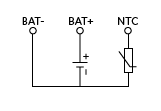
Most lithium-ion batteries with three terminals are equipped with an internal NTC thermistor.

When using NTC thermistor At this point, it should be connected between the THM pin and ground (via the BAT connection). A resistor (R7) is also connected between the THM pin and the reference voltage (VL), forming a voltage divider. The resistor value is chosen so that, at +25°C, it has the same resistance as the NTC thermistor. At +25°C, the voltage at the THM pin equals 0.5 × VL. As the temperature rises or falls, the NTC thermistor’s resistance decreases or increases, respectively, causing the voltage at the THM pin to decrease or increase accordingly. The device will only charge when this voltage is between 0.28 × VL and 0.74 × VL. For modern NTC thermistors, this corresponds to temperatures ranging from 0°C to 50°C. If no NTC thermistor is available, R8 should be added, which will set the voltage at the THM pin to 0.5 × VL.
If you’re reusing a smartphone battery, it typically comes with built-in protection circuitry that prevents overcharging and deep discharging. However, if you’re using a single cell—such as one removed from an old device’s battery pack—you’ll need to design your own protection circuit. The circuitry inside a battery pack is engineered to safeguard the entire pack and cannot be used to protect an individual cell.
A simple fuse (labeled FS1 in Figure 4, and implemented as a surface-mount device or SMD fuse on the PCB) provides adequate overcurrent protection, ensuring that the battery can be used safely. However, the fuse offers no protection against deep discharge. Over‑discharging such batteries can lead to permanent damage, which may occur if an ohmic load—such as a small incandescent bulb—is left connected for an extended period. That said, once the supply voltage drops below a certain threshold, most devices will shut down, thereby preventing further discharge. Consequently, whether the fuse provides sufficient protection largely depends on the type of connected load.
Huizhou Jin Yuan Xiang Electronic Co., Ltd. is a high-tech enterprise that manufactures NTC thermistor NTC temperature sensor Temperature probe. Feel free to request a quote with images. Free sample available.
Previous Page: Do electric scooter batteries use NTC thermistors?
Next page: NTC temperature sensor for smart water dispensers
Latest Updates


Contact Us
+86-137 9451 4154(Miss Jiang)
Add: Room 01, 8th Floor, 3rd Building, Daya Bay KeChuang Huizhou Software Park, No. 28, Longshan 2nd Road, Daya Bay West District, Huizhou, China
Wechat / Whatsapp / Telegram:
Scan with WeChat
Power by:www.300.cn
